Can Ripple’s Fed Master Account Approval Trigger A New XRP Bull Run? AI Model Says $80 Is Possible

Ripple’s possible approval to hold a Federal Reserve (Fed) master account could be the spark that pushes XRP into another major phase of upside momentum.

Fed Settlement Access

In his latest report, market analyst Sam Daodu said AI models broadly agree that XRP may rise if Ripple gains access to Fed settlement infrastructure. 

A major reason behind the optimism is that Fed access would allow Ripple to settle directly through those rails, rather than routing transactions through banks that currently act as middlemen. 

Daodu suggested the process may already be moving toward reality. In March 2026, Kraken became the first crypto firm to receive a master account through the Federal Reserve Bank of Kansas City, which he cited as evidence that the approval pathway is no longer purely theoretical.

Building on this development, Daodu shared model-driven forecasts for XRP, drawing comparisons between various AI systems and their respective approaches to weighing catalysts and risks. 

XRP Forecasts Watch

According to Daodu, ChatGPT points to a measured recovery under base conditions. The model places XRP in a $2.50 to $3.00 range by August 2026, while also flagging $1.50 as a key level XRP needs to hold for the prediction to remain on track. 

Currently, the altcoin is trading well below that level, having retraced to $1.32 per token. Still, Daodu said that the rationale centres on exchange-traded fund (ETF) inflows and growth in Ripple’s payment corridor. 

XRP

In a more bullish scenario—assuming ETF inflows and corridor growth accelerate meaningfully through the second half of the year—ChatGPT sees upside to $5. 

Grok’s projections are more aggressive at the top end, according to Daodu. Grok’s base forecast lands between $2.50 and $2.80, but it lifts the upper target to $10 under the right conditions. Daodu reported that Grok links the $10 level to a scenario in which Bitcoin clears $100,000. 

Why $80 Could Happen By 2032?

Claude’s outlook is described as more cautious, though it still leaves room for gains. The model’s base projection, Daodu said, calls for XRP to remain in the $1.35 to $1.65 range for the rest of 2026, with a 50% probability assigned to that outcome. 

Claude’s reasoning points to a familiar pattern: momentum can spark short-term rallies, but those moves may fade quickly if there is no fresh catalyst to extend the trend. At the same time, Claude’s longer-term view is more constructive than the base case. 

It leaves room for XRP to reach between $8 and $14 if ETF inflows exceed $10 billion and banking adoption accelerates. Still, Claude stresses that price alone cannot carry XRP to those levels; the market would need sustained demand drivers to support the move.

Among the models Daodu reviewed, Vincent Van Code’s AI forecast is presented as the boldest. Rather than focusing on a single near-term target, Vincent Van Code maps a year-by-year trajectory that reaches $80 by 2032. 

The foundation for that call is Ripple CEO Brad Garlinghouse’s projection that 30% of Ripple Treasury’s $13 trillion annual payment flow could move on-chain within five years. For 2026 specifically, the AI model targets price targets ranging from $6 to $10.


from NewsBTC https://ift.tt/9fV7QGn

JPMorgan CEO Goes Nuclear On CLARITY Act, Calling Coinbase’s Armstrong ‘Full Of S-t’

As lawmakers advance the crypto bill closer to completion, JPMorgan CEO Jamie Dimon attacked Coinbase CEO Brian Armstrong and criticized the CLARITY Act on Friday.

Dimon Predicts Clash Over CLARITY Act

Speaking at the Reagan National Economic Forum, Dimon said banks “will not accept” the CLARITY Act in its current form. He also suggested that efforts by crypto proponents are unlikely to produce a broad consensus with traditional financial institutions. 

“It will be fought. No one’s gonna bow down to this guy, or that company,” Dimon said, referring to the act and Armstrong. Dimon continued: “He’s the only one, and he’s spending hundreds of millions of dollars in Washington on this thing… He’s full of shit.”

As reported by NewsBTC on Thursday, the bill advanced in the Senate earlier this month. The Senate Banking Committee approved its portion, building on earlier progress from January, when the Agriculture Committee successfully voted on its version of the legislation.

After a full Senate vote, lawmakers would need to complete the reconciliation steps required to finalize the measure and then secure agreement between the House and the Senate. Only after those steps would the final text move to the president for consideration.

Yield And Compliance Provisions Concerns

Dimon argued that the bill contains fundamental problems. He said the legislation would allow banks to earn interest on deposits, stablecoins, or related instruments “without the protection they should have,” and he also contended that it fails to address anti-money laundering (AML) and Bank Secrecy Act requirements sufficiently. 

“It allows them to effectively pay interest on deposits, stablecoins, or something like that, without the protection they should have. And it does not do anything for AML/BSA,” Dimon said.

The executive further emphasized that the pushback would not be limited to a single type of institution or one segment of the industry. He said banks of different sizes would oppose the CLARITY Act as currently written, arguing that unity spans both large and smaller players. 

“The banks will not accept it that way,” Dimon said. “The ABA [American Bankers Association], the small banks, the credit unions. It’s not just the big guys.”

CLARITY Act

Featured image from CNBC; chart from TradingView.com


from NewsBTC https://ift.tt/CUTuaS0

XRP Analyst Flags Biggest Institutional Unlock That The Market Has Ever Seen

A popular XRP community figure is making a case that the XRP Ledger is on the cusp of a transformation that would change how institutional capital works with decentralized infrastructure. The comment was based on the newly proposed AMM Swappable Curves standard, which seeks to improve XRPL’s native automated market maker beyond the existing XLS-30 design. The proposal is still at the community review and amendment stage, but it is already a major talking point among XRP supporters.

XRPL’s Native AMM Could Be Set For A Major Amendment

The current XRPL native AMM is based on XLS-30, which brought automated market maker functionality to the XRP Ledger and connected it directly to the network’s decentralized exchange. This allows XRPL trades to tap into AMM pools, the order book, or a mix of both, depending on where liquidity is best available.

The proposed AMM Swappable Curves standard would build on that foundation by introducing a pluggable curve architecture. According to the draft posted under XRPL Standards discussion #547 on GitHub, pool creators would be able to choose the invariant function at pool creation. The initial set includes ConstantProduct, ConcentratedLiquidity, and StableSwap curves, with Smart AMM pools reserved for a later companion specification.

Furthermore, the current XLS-30 model uses a single constant-product structure. Constant-product pools are useful for volatile pairs, but they spread liquidity across the full price range. The new proposal is because this is inefficient for correlated assets, especially stablecoin pairs, FX pairs, and tokenized assets that usually trade close to a narrow value range.

Biggest Institutional Unlock XRP Has Ever Seen

X Finance Bull described the proposed AMM Swappable Curves updates on the XRP Ledger as possibly the biggest institutional unlock XRP has ever seen, and XRPL’s native DEX is about to receive a major liquidity infrastructure upgrade. 

According to him, the upgrade is comparable to the kind of innovation that helped turn Uniswap V3 into a dominant DeFi trading venue on Ethereum, but with the XRP Ledger’s advantages of burned fees, fast transaction settlement, and very low transaction cost.

He explained that the main reason institutions may care is execution quality. Large stablecoin swaps between RLUSD and USDC could be carried out with almost zero price impact, which is the kind of standard that banks require before moving serious volume through any venue. From here, tighter FX pair settlement and more practical RWA trading at an institutional scale could follow if liquidity becomes more efficient.

X Finance Bull also pointed to the benefits for capital providers, noting that they could earn stronger returns by focusing liquidity where it matters most instead of spreading it thinly across the entire market. This will create a flywheel effect, where better pools attract more volume, higher volume attracts more liquidity providers, and better liquidity attracts larger institutions. XRPL is becoming competitive with every major DeFi venue on earth. 

XRP price chart from Tradingview.com

from NewsBTC https://ift.tt/ty1azEd

Treasury Secretary Urges CLARITY Act Passage, Saying The US Should Be Home For Crypto

On Thursday, Treasury Secretary Scott Bessent urged Congress to pass the CLARITY Act, a bill that would provide the crypto industry with a regulatory framework and the long-awaited clarity it needs regarding the classification of digital assets. 

Bessent Presses Lawmakers To Pass The CLARITY Act 

In remarks at the White House, Bessent emphasized that the goal of the CLARITY Act should be to bring digital assets into the US rather than letting activity remain largely offshore. He said: 

The most important thing we can do is to make digital assets come into the United States. Make the US the home. I would encourage the House and the Senate to get Clarity done.

Bessent’s comments also targeted what he called the “wild, wild west” environment for digital assets outside the US. He argued that much of the confusion and controversy surrounding crypto stems from a lack of clear rules when the activity is happening offshore. 

“When you look at digital assets, all the nonsense that happens, all the things you read about, that’s because it’s the wild, wild west offshore. So we got to bring it onshore,” he said, before urging lawmakers again to “get CLARITY Act done.”

CBDCs Off The Table

The push comes after the CLARITY Act moved forward in the Senate earlier this month. The Senate Banking Committee approved its portion of the legislation, building on progress from January, when the Agriculture Committee successfully voted on its version. 

With those committee steps completed, the CLARITY Act must clear a full Senate vote, complete the legislative reconciliation steps required to finalize the bill, and secure a final agreement between the House and the Senate before the measure can move to the President’s desk.

Bessent also addressed the administration’s broader crypto policy direction, including central bank digital currencies (CBDCs). He said the US would not adopt a Central Bank Digital Currency, stating, “There will be no Central Bank Digital Currency. That would be the first step toward tracking. We took that off the table.” 

CLARITY Act

Featured image created with OpenArt; chart from TradingView.com 


from NewsBTC https://ift.tt/3aXVCT2

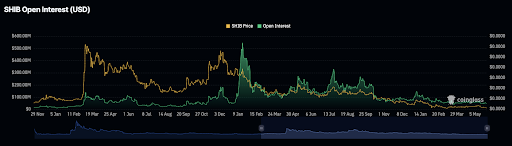
Shiba Inu OI Crashes Over 30%, SHIB Burns Grind To A Halt; Is This The End?

The Shiba Inu (SHIB) price has remained under strong pressure this year as weak demand and fading market momentum continue to weigh on the meme coin. Beyond the price decline, new data now show that Shiba Inu’s Open Interest (OI) has crashed by more than 30%, while its burn rate has also slowed significantly. The decline in these key metrics points to weakening investor interest, lower trading activity, and reduced network engagement. Combined with Shiba Inu’s ongoing price struggles, these growing bearish signals have raised concerns about whether Shiba Inu is losing the strength that once made it the second-largest meme coin in the crypto market. 

Shiba Inu Open Interest Crashes As Price Plummets

On May 27, data from Coinglass revealed that Shiba Inu’s Open Interest had dropped by 6% to $49.4 million, signaling weakness in futures activity and a decline in investor confidence in the meme coin. During the same period, Shiba Inu’s futures flow plunged by a staggering 190%, with outflows reaching $5.6 million, far exceeding the previous inflows of around $4.74 million. 

Notably, this sharp decline pushed the net difference to $865,790 in total closed Shiba Inu contracts within 24 hours. The heavy outflow also wiped out roughly 156.56 billion SHIB tokens from the futures market, underscoring the ongoing decline in speculative trading activity. 

Shiba Inu

Fast forward to today, Shiba Inu’s Open Interest has dropped an additional 5.6% to around $46.44 million. This suggests that traders are still closing positions at a rapid pace as bearish sentiment continues to dominate the market. The continued decline in leverage activity also reflects weakening sentiment among short-term investors, with many appearing unwilling to place strong bullish bets on SHIB’s near-term recovery

This bearish shift comes as the meme coin’s price experiences prolonged volatility and market swings. According to CoinMarketCap’s data, Shiba Inu has been on a steady decline throughout this month. Its price has fallen by over 14% in the last 30 days and by more than 63% year-to-date.

At the time of writing, the meme coin remains in the red, with its recent price correction driven by increased selling pressure and a drop in Bitcoin’s price. Other factors contributing to SHIB’s low price are the broader weakness in the meme coin market, which has also affected coins like Dogecoin (DOGE).  

SHIB Burn Rate Dwindles To Surprising Lows

Another metric that has surprisingly taken a hit is Shiba Inu’s burn rate. According to the meme coin’s burn tracker, Shibburn, just $2 worth of SHIB tokens were burned on May 26, highlighting a sharp slowdown in activity and adding more pressure to the already bearish market. 

Notably, the Shiba Inu ecosystem is widely known for conducting large-scale token burns, with many community members believing that a continued decline in supply could create sufficient scarcity to support a future price explosion. However, recent on-chain reports now show that this usually active burn mechanism has taken a pause.

Shibburn also revealed that only about $11 worth of tokens were burned over the last 24 hours, representing just over 2.05 million SHIB. In the past week, less than $100 worth of tokens was removed from circulation, indicating weakening interest in the meme coin and a clear lack of interest in helping reduce SHIB’s supply.

Shiba Inu

from NewsBTC https://ift.tt/BojGRKl

Ethereum (ETH) Drops Below $2,000—Why Standard Chartered Still Expects $40,000 By 2030

Ethereum (ETH) has followed Bitcoin (BTC) and much of the wider crypto market lower over the past 48 hours, dropping below the key $2,000 support level and reigniting concerns among some investors that a longer bear phase could be underway. 

Even with the recent slide, Standard Chartered’s Digital Assets Research Head, Geoff Kendrick, says the bank is not backing away from its bullish long-term outlook for Ethereum.

Ethereum Price Will Catch Up

In a note to investors on Thursday, Kendrick reaffirmed Standard Chartered’s core projection for Ethereum’s performance over the next four years, including its end-2030 target of $40,000 for ETH. 

He linked the current weakness to something investors may eventually look back on as a confusing, even misleading, signal. Rather than treating the price drop as proof that the network is weakening, Kendrick argued that Ethereum’s usage metrics are continuing to improve even as the token’s market value loses ground.

To illustrate the gap between price action and underlying progress, Kendrick drew a comparison to Amazon during the 2001 dot-com bust. His argument echoes a line often attributed to Jeff Bezos: that while a company’s stock can go the wrong way, “everything inside the company” can still be moving in the right direction. 

Kendrick specifically said that Ethereum will “catch up” to those improving internal metrics and suggested that investors are effectively watching a delay between operational strength and market pricing. 

ETH Upside Signals

Standard Chartered’s view leans heavily on measurable indicators that Kendrick says support Ethereum’s position in key parts of the crypto economy

One of the bank’s central points is Ethereum’s role in stablecoins. Kendrick noted that 54% of all stablecoins are currently issued on the network. He also said stablecoins make up around one-third of all Ethereum transactions in 2026 year-to-date. 

Based on that momentum, Standard Chartered projects the stablecoin market cap could increase sixfold from current levels by the end of 2028.

A second major pillar of the bullish case is Ethereum’s position in tokenized real-world assets (RWAs). Kendrick said Ethereum hosts around 62% of RWAs and about 68% of active on-chain loans. 

He projected that the non-stablecoin RWA sector could grow about 50 times to reach $2 trillion by the end of 2028. For Standard Chartered, tokenized RWAs are likely to expand in a way that brings Ethereum a significant share of the activity. 

Kendrick’s projections suggest Ethereum could still capture roughly half to two-thirds of both tokenized assets and the related category of growth, with Ethereum hosting an estimated 50% to 65% of those segments.

Kendrick’s analysis keeps the forecast unchanged: ETH at $4,000 by the end of 2026 and then $40,000 by the end of 2030. In the same reaffirmation, Standard Chartered lays out an extended path through the intervening years, projecting $10,000 by end-2027, $18,000 by end-2028, and ultimately $40,000 by end-2030.

Ethereum

At the time of writing, ETH was trading at $1,991, having retraced by 5% in the weekly timeframe. This means that the altcoin is now trading 59% below its all-time high of $4,964, reached last year. 

Featured image created with OpenArt; chart from TradingView.com


from NewsBTC https://ift.tt/P0Mu31q

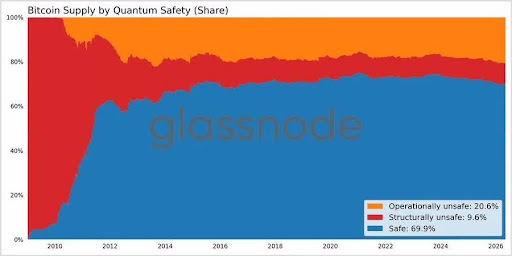
Glassnode Warns Nearly 30% Of Bitcoin Supply Could Face Future Quantum Risks

Bitcoin’s long-term security model is once again under the spotlight following new data from Glassnode suggesting that the network could face theoretical risks in a future dominated by quantum computing. The report shows that a significant portion of BTC’s circulating supply could be vulnerable in the future if quantum technology advances to the point where it can break current cryptographic protections.

Glassnode’s Data Reveals The Scale Of Potential Future Exposure

New data from Glassnode, an on-chain data analytics platform, has shed light on a potential long-term change facing Bitcoin’s security model. Crypto trader Evans revealed on X that the analysis estimates that approximately 6.04 million BTC, nearly 30% of the total BTC supply, could theoretically be at risk from future quantum computing threats. 

This is because the public keys associated with those coins have already been exposed on-chain. However, what stands out even more is that roughly 4.12 million BTC of the risk is associated with address reuse and outdated custody methods that unnecessarily increase public-key exposure.

Bitcoin

In addition, the data also indicates that centralized exchanges collectively hold more than 1.6 million BTC in potentially exposed addresses.

Comparing Current Volume Collapse To The 2023 Bear Market

Bitcoin spot trading volumes have collapsed by approximately 81% since October 2025, pushing market activity back to levels typically associated with bear market conditions. A Verified Author for CryptoQuant, known as Darkfost, has pointed out that to find similarly low participation, one would have to look back to July 2023, highlighting just how sharply spot volumes have declined.

Despite the broader slowdown, major exchanges like Binance continue to dominate the market with $36.4 billion in trading volume, and recorded $198.6 billion in October 2025. Therefore, volumes are nearly 5 times lower in the current market, representing 81% decline, and Binance is far from an isolated case.

Meanwhile, Gate.io has also seen a massive 79.6% drop in volumes, and Bybit is down 66%. This development primarily reflects a macro environment that has been unfavorable for risk assets such as cryptocurrencies. The persistently rising inflationary pressures and the prolonged US-Iran tensions have pushed investors toward preferred commodities and traditional equity indices over crypto markets.

According to Darkfost, this dynamic can also be interpreted constructively. The sharp decline in trading activity shows that the selling pressure behind the current retracement is gradually losing momentum.

Historically, prolonged periods of weak spot volume have often coincided with the later stages of market corrections, when selling pressure begins to exhaust itself, and speculative excess is flushed from the system. Notably, a similar collapse in trading activity occurred near the end of the 2023 bear market before volatility returned and the bullish trend recovered.

Bitcoin

from NewsBTC https://ift.tt/zlIha82
✕ Close